Overview
Australia's Tranche 2 AML/CTF reforms introduced new AUSTRAC obligations for law firms and conveyancers, requiring them to establish compliant operational programs by July 2026. With new requirements spanning client identity verification, risk assessments and sanctions screening, many firms faced significant administrative pressure without the digital infrastructure to manage these obligations efficiently.
To address this emerging market need, InfoTrack set out to build an end-to-end AML/CTF Compliance Centre from the ground up, ahead of the regulatory deadline. Over the first four months, I was one of the lead Product Designers contributing to the product's 0–1 development, helping shape the core platform experience, establish foundational design system components and validate key workflows through user research. My focus was translating complex regulatory requirements into intuitive, structured and audit-ready experiences for legal professionals. You can explore the live product via the InfoTrack AML/CTF Compliance Centre overview.
Project details
Role
Product designer
Responsibilities
Owned 3 Compliance Centre products covering staff training, staff onboarding and client onboarding. Also conducted 6 client interviews to understand how firms manage cybersecurity and gather feedback on InfoTrack Shield designs.
Team
Large scale team involving software engineers, product managers, account managers, sales, and product designers
Timeline
November 2025 to October 2026
Impact
Industry recognition: Won the 2026 Australian Good Design Award for Commercial and Industrial Product Design.
Delivered to regulatory deadlines: Designed and delivered a foundational 0–1 compliance platform from the ground up, meeting the mandatory AUSTRAC deadline.
Accelerated market adoption: Onboarded thousands of legal practices in the first quarter, reaching over 50% adoption across target accounts by H2 2026.
Commercial growth: Met key business targets by October 2026, contributing to multi-million-dollar revenue growth across the compliance product vertical.
Successful Shield pilot: Conducted cybersecurity research and gathered early design feedback, informing product improvements ahead of launch. Reached 10 active enterprise firms on the Shield dashboard by late October 2026.
Problem space
Australia's Tranche 2 AML/CTF reforms introduced significant new compliance obligations for law firms and conveyancers, requiring them to meet strict regulatory standards within tight deadlines across InfoTrack's AML/CTF ecosystem. Our team faced considerable ambiguity in translating these requirements into a digital experience, working from dense regulatory documents and paper-based processes that weren't designed for modern software.
The challenge was to turn complex legislation into practical, everyday workflows. Using guidance from external compliance advisors, we worked to understand the requirements, map compliance processes and identify opportunities to simplify them. This included reducing repetitive data entry, consolidating third-party verification steps and creating a more integrated compliance experience within InfoTrack's legal workspace.
Following the initial platform rollout, I led six qualitative research sessions with solicitors, conveyancers and practice managers in August and September 2026. The research aimed to validate early designs for InfoTrack Shield, a centralised dashboard within the Compliance Centre that gives practice managers visibility into firm-wide AML readiness, staff training completion and risk escalations. We also explored how firms manage cybersecurity, payment fraud and professional indemnity insurance requirements.
Design ownership
From the AML CTF Compliance Centre, I took primary end to end UI and UX ownership of three core products:
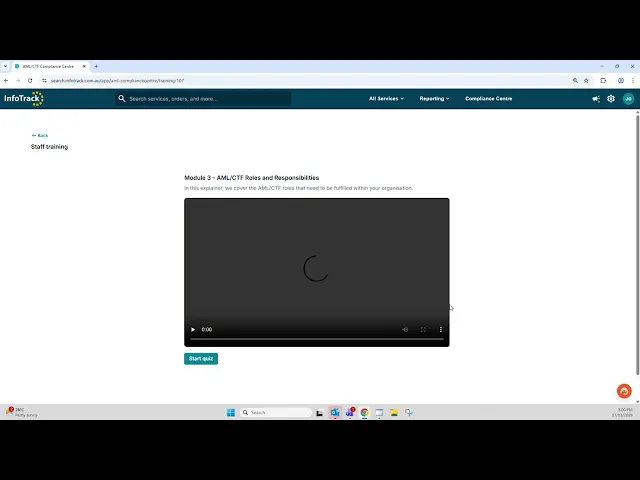
Staff training
InfoTrack offers a complimentary, all-inclusive AML/CTF Compliance Centre developed in collaboration with Grant Thornton Australia to help legal, conveyancing, accounting, and real estate firms meet Australian Tranche 2 obligations.
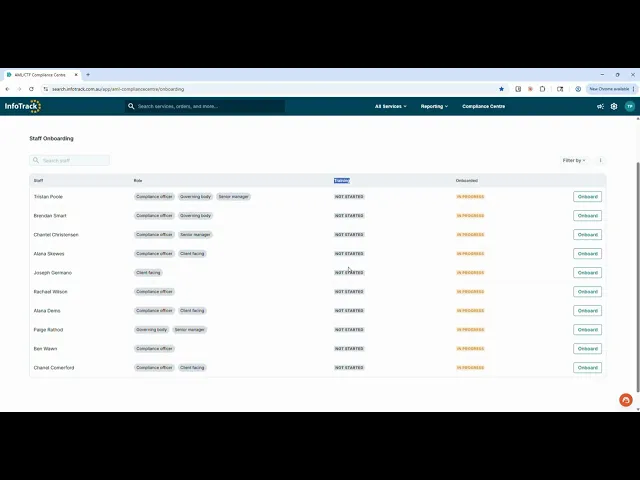
Staff onboarding
InfoTrack’s staff onboarding process is managed directly inside the InfoTrack AML/CTF Compliance Centre to help firms prepare for AML/CTF obligations.
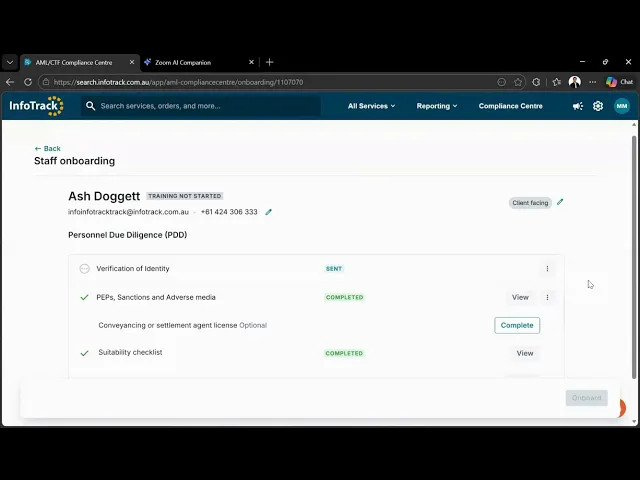
Individual client onboarding
Individual client onboarding workflow demonstrating KYC verification and identity checks. Explore more details on AML onboarding and VOI here.
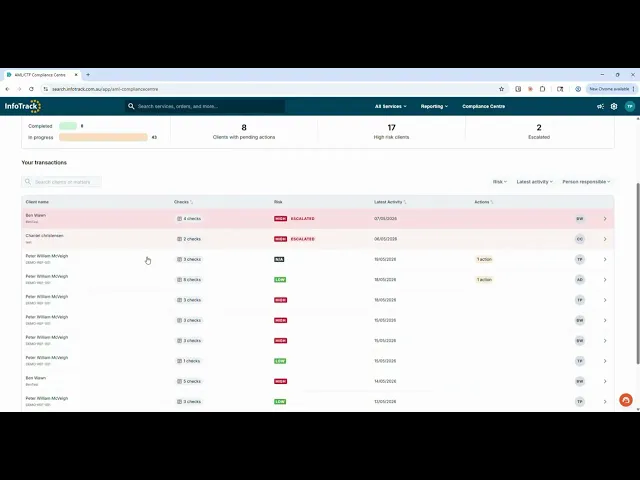
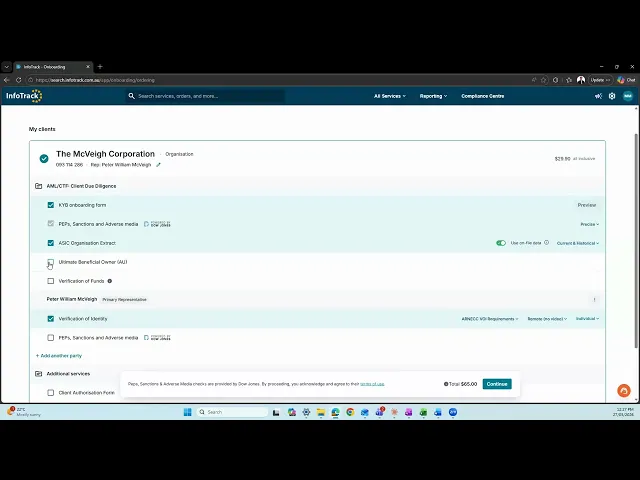
Organisation client onboarding
Organisation onboarding workflow.
Design Validation for InfoTrack Shield
Key findings from cybersecurity research and early InfoTrack Shield design validation ahead of the pilot launch.
Firms managing cyber security
Firms rely on their software and IT providers for security
All 6 firms depend on external providers to manage cybersecurity. Smaller firms see this as a deliberate choice.
Payment fraud is a shared concern, but verification is rarely documented
5 of 6 firms confirm bank details over the phone, yet only 2 keep a record of these checks.
Firms struggle to prove they meet compliance requirements
None could show when staff were trained, when policies were last reviewed, or whether bank details were verified. This is a concern given that insurers often require this evidence for cover.
InfoTrack Shield design feedback
Readiness and analytics features resonated with firms
The readiness panel, staff activity tracking and prioritised action list were the most valued features. They help firms monitor staff activity without manually checking each employee.
Role-based permissions are essential
Escalated matters and suspicious matter reports must only be accessible to compliance officers. This is a legal requirement, not simply a user preference.
Outcomes and learnings
I transformed 30+ page paper-based regulatory questionnaires into a streamlined digital experience, translating complex compliance requirements into clear, easy-to-use workflows. Working from regulatory guidance shared by subject matter experts and collaborating with internal teams taught me how to navigate ambiguity and turn dense legal requirements into practical software solutions. I also learned that clear UX plays an important role in reducing compliance risk. By removing redundant inputs and making status indicators easier to understand, we helped legal professionals manage their compliance obligations with greater confidence.